Longevity Is Not More Years. It Is More Life in Your Years.
Modern longevity science is confirming an old truth: added years mean little without strength, clarity and purpose. What the evidence shows, what is still uncertain, and what is being sold ahead of it.
Guru AnandSeptember 17, 202617 min read
Modern longevity science is beginning to confirm an old truth: a long life has little meaning if strength, clarity, mobility and purpose disappear too early. The real goal is healthspan — the period of life lived with functional capacity and relative freedom from disabling disease. From skeletal muscle and sleep to fasting, stress and yogic discipline, this is what the evidence genuinely tells us, what remains uncertain, and what the longevity marketplace is selling before science has caught up.
The question is not only "how long will I live?"
Human beings have always searched for a longer life. Yet perhaps we have been asking an incomplete question.
What is the value of adding years if those years are emptied of mobility, independence, memory, curiosity and participation? Lifespan counts the years between birth and death. Healthspan asks how many of those years can be lived with meaningful physical and mental function.
These are not identical outcomes. Medicine can sometimes extend survival without restoring full function. Conversely, a person may enter later life with fewer medicines, greater strength and a wider circle of participation — not because ageing has been defeated, but because capacity has been preserved.
This distinction changes the entire conversation. Longevity stops being a contest against wrinkles and becomes a practice of protecting function.
The purpose of longevity is not to become endlessly old. It is to remain deeply alive.
What actually happens when we age?
Ageing is not caused by one switch, one hormone or one damaged gene. It is a network of interacting biological changes.
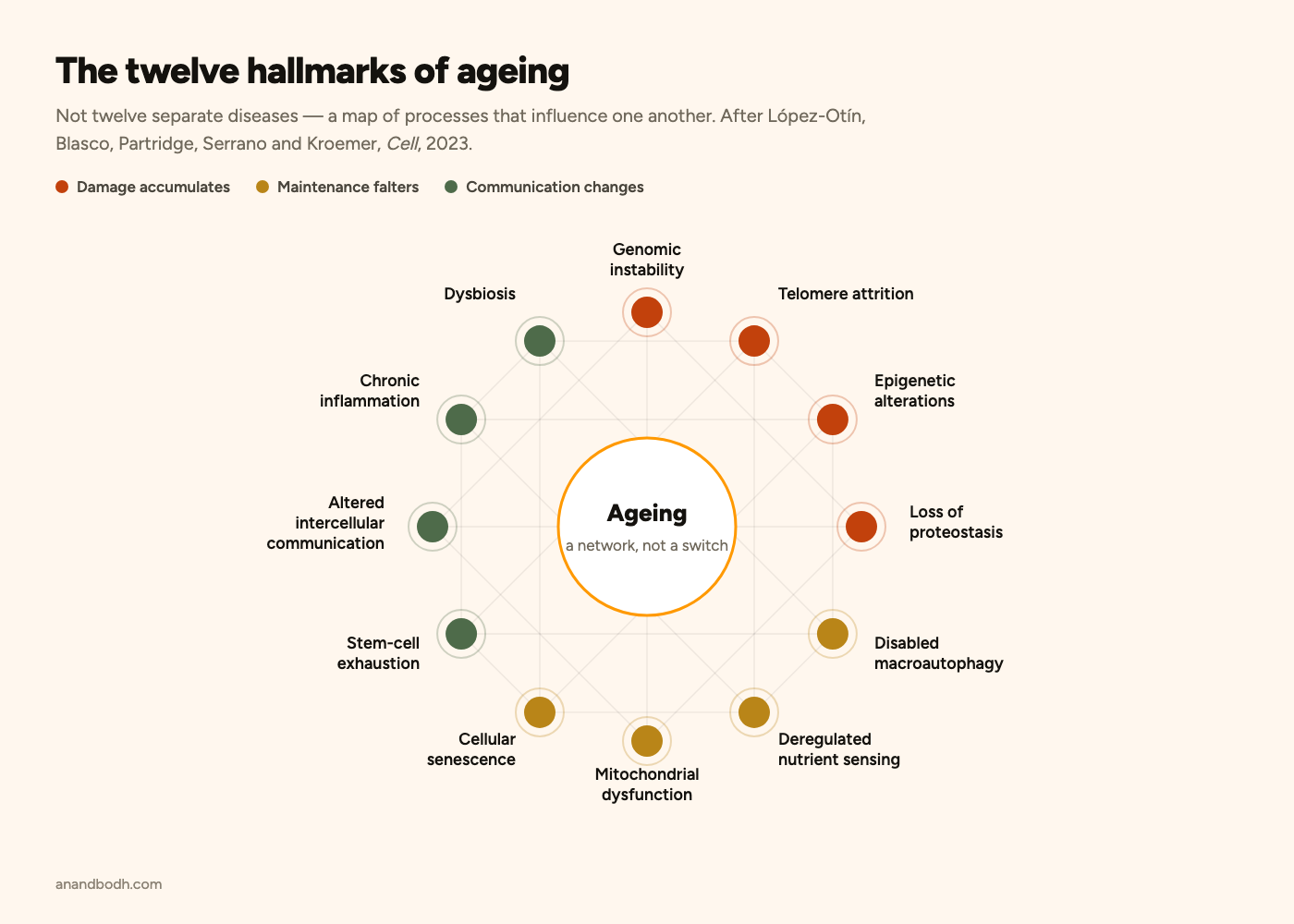
The twelve hallmarks of ageing
The updated scientific framework describes twelve interconnected hallmarks: genomic instability, telomere attrition, epigenetic alterations, loss of proteostasis, disabled macroautophagy, deregulated nutrient sensing, mitochondrial dysfunction, cellular senescence, stem-cell exhaustion, altered intercellular communication, chronic inflammation and dysbiosis ([López-Otín et al., Cell, 2023](doi.org/10.1016/j.cell.2022.11.001); PMID 36599349).
These hallmarks are not twelve separate diseases. They are a map of processes that influence one another. Mitochondrial dysfunction may disturb cellular energy; damaged proteins may accumulate when quality-control systems weaken; senescent cells may alter communication between tissues; and persistent inflammation may amplify several other forms of dysfunction.
The framework is scientifically useful, but it is not a household diagnostic checklist. Commercial "biological age" products may measure selected biomarkers, yet no single consumer test captures all twelve hallmarks or reliably tells an individual exactly how long they will remain healthy.
Established, emerging and marketed
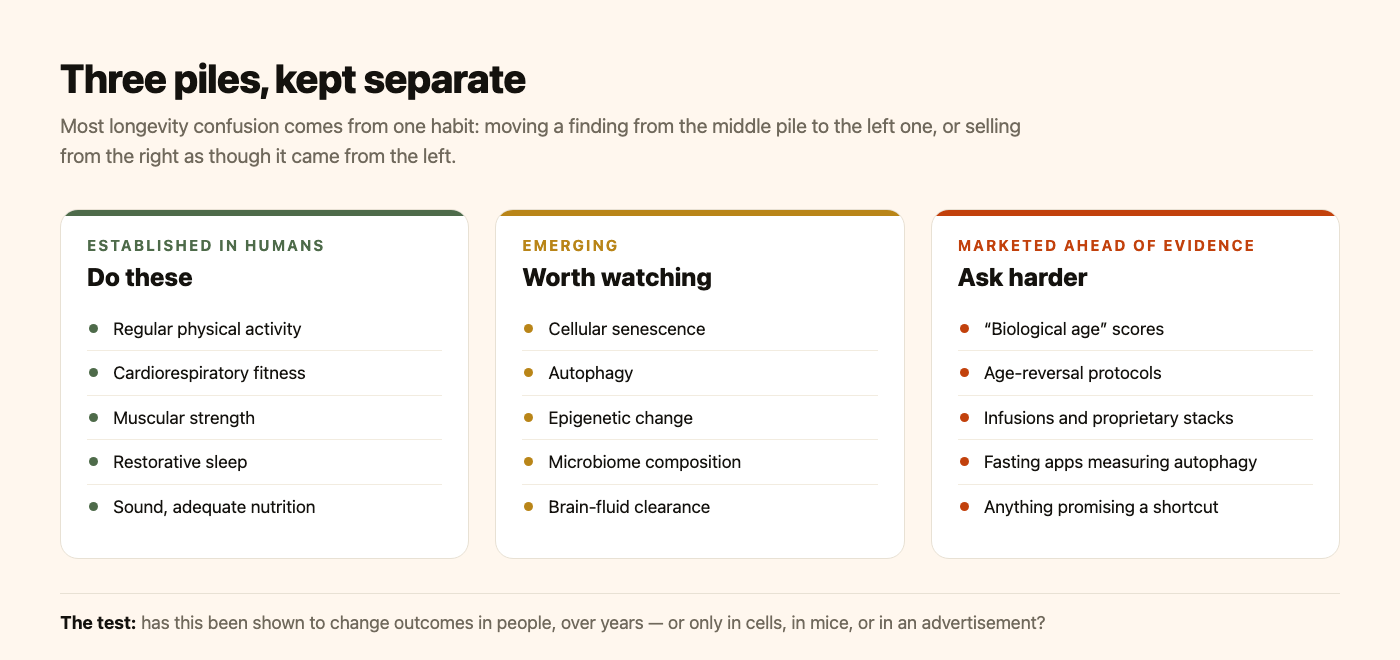
A disciplined longevity conversation must keep three categories separate.
Established. Regular physical activity, cardiorespiratory fitness, muscular strength, restorative sleep and sound nutrition are associated with better health and functional outcomes in humans.
Emerging. Researchers are investigating how cellular senescence, autophagy, epigenetic change, microbiome composition and brain-fluid clearance might become useful clinical targets.
Marketing. Claims that a proprietary test, supplement, infusion or "age-reversal protocol" can accurately turn back an individual's biological clock often travel far beyond evidence from long-term human outcomes.
The map is real. The promise that someone can sell us a shortcut through it is much less certain.
Muscle is more than machinery
For many years, muscle was discussed mainly in terms of movement and appearance. Research now describes skeletal muscle as a secretory organ: contracting muscle fibres release signalling molecules, often called myokines, that can act within muscle and communicate with tissues including the liver, fat, pancreas, bone and brain ([Pedersen and Febbraio, Nature Reviews Endocrinology, 2012](doi.org/10.1038/nrendo.2012.49); PMID 22473333).
This does not mean that every myokine has a proven clinical application. It means that movement creates biochemical communication as well as mechanical work.
Muscle is also part of our reserve capacity. It allows us to rise from a chair, carry groceries, recover after illness and steady ourselves when balance fails. Longevity therefore cannot be separated from strength, power and the repeated use of the body.
The quiet importance of the soleus
The soleus sits deep within the calf and contains a high proportion of slow oxidative fibres. These fibres are adapted for sustained, fatigue-resistant activity and rely heavily on oxidative metabolism.
In a small controlled human laboratory study, Hamilton and colleagues tested a specifically instructed seated "soleus push-up." Sustained soleus contractions increased local oxidative metabolism and improved postprandial glucose and triglyceride handling during the experimental sessions ([Hamilton et al., iScience, 2022](doi.org/10.1016/j.isci.2022.104869); PMID 36034224).
This finding is intriguing, but its limits matter. It was an acute laboratory study with small samples and surrogate endpoints — not evidence that calf raises extend life, reverse diabetes or replace walking, aerobic exercise or resistance training. The movement also involved a particular technique designed to maximise soleus activity; casually bouncing one's heels should not automatically be assumed to reproduce the published protocol.
What the study reinforces is a broader principle: muscle activity during otherwise sedentary time can influence metabolism.
That principle is supported beyond the soleus experiment. In a small crossover trial of ten older adults at risk of impaired glucose tolerance, both three 15-minute post-meal walks and one sustained 45-minute walk improved 24-hour glycaemic control; the post-meal walks were the more effective of the two specifically at lowering glucose after the evening meal ([DiPietro et al., Diabetes Care, 2013](doi.org/10.2337/dc13-0084); PMID 23761134).
The deeper message is wonderfully ordinary: the body was not built to complete one ceremonial workout and then remain motionless for the rest of the day.
Two measures of functional reserve
VO₂max: the size of the aerobic engine
VO₂max represents the highest rate at which the body can take in, transport and use oxygen during intense exercise. It reflects the combined performance of the lungs, heart, circulation and working muscles.
Large observational studies consistently associate greater cardiorespiratory fitness with lower long-term mortality. In a cohort of 122,007 adults referred for treadmill testing, higher estimated cardiorespiratory fitness was associated with lower all-cause mortality across the fitness range ([Mandsager et al., JAMA Network Open, 2018](doi.org/10.1001/jamanetworkopen.2018.3605); PMID 30646252).
This is strong prognostic evidence, but it is observational, and in a clinically referred population rather than the general public. Fitness may reflect physical activity, genetics, existing illness and other advantages. The study shows association, not proof that pursuing a particular VO₂max number guarantees a longer life.
VO₂max is also not the only meaningful fitness measure. For many people, walking tolerance, recovery, balance and the ability to climb stairs may be more relevant starting points.
Grip strength: a small test of a larger system
Grip strength is easy to measure, but it should not be mistaken for a hand-only phenomenon. It reflects aspects of muscle function, neurological coordination, nutritional status and general health.
In the multinational PURE study, lower grip strength was associated with higher all-cause mortality, cardiovascular mortality and incident cardiovascular disease; the paper reports it as a stronger predictor of mortality than systolic blood pressure in that cohort ([Leong et al., The Lancet, 2015](doi.org/10.1016/S0140-6736(14)62000-6); PMID 25982160).
Prediction is not causation. Grip strength is a useful signal, not a verdict: a low reading does not identify one cause, and squeezing a hand-grip device alone does not address every factor the measurement represents.
Sleep is active maintenance, not lost time
Sleep is sometimes treated as an interruption to productive life. Biology treats it differently.
During sleep, the brain changes state. In mice, sleep and anaesthesia were associated with increased interstitial space and faster clearance of metabolites — β-amyloid among them — from brain tissue through a pathway commonly described as glymphatic transport ([Xie et al., Science, 2013](doi.org/10.1126/science.1241224); PMID 24136970).
That landmark experiment was conducted in mice. It should not be translated into the simplistic claim that one good night's sleep "detoxes" the human brain.
Human evidence is developing and is deliberately hedged by the researchers themselves. Contrast-based imaging studies have reported sleep–wake differences in putative glymphatic activity ([Lee et al., Radiology, 2021](doi.org/10.1148/radiol.2021203784)), while another study found that sleep deprivation impaired clearance of an intrathecally administered tracer from the human brain ([Eide et al., Brain, 2021](doi.org/10.1093/brain/awaa443)). Both are small, indirect tracer studies.
Glymphatic measurement in living people remains technically difficult, and the field is still refining what various imaging signals mean.
Established: sleep is essential to human health and function. Emerging: sleep appears to influence fluid transport and molecular clearance in the human brain. Marketing: any product claiming to "clean the brain overnight" should face a standard higher than an attractive animation.
Protein, fasting and the danger of half-truths
Nutrition becomes noisy when a finding in a mouse is presented as a commandment for every human.
Protein: necessary, but context matters
Protein supplies amino acids required for the maintenance and repair of body tissues. In a meta-analysis of resistance-training studies in healthy adults, protein supplementation produced additional gains in muscle mass and strength, with the benefit plateauing at an estimated total intake of about 1.62 g per kilogram of body weight per day ([Morton et al., British Journal of Sports Medicine, 2018](doi.org/10.1136/bjsports-2017-097608); PMID 28698222).
That number deserves care rather than reverence. It is a meta-regression breakpoint with a 95% confidence interval of 1.03 to 2.20 g/kg/day, and the authors themselves suggest a practical figure nearer 2.2 g/kg/day. Requirements and safety considerations vary with age, body size, activity, total energy intake, illness and kidney or liver status. Protein also cannot compensate for the absence of resistance exercise; building and preserving muscle requires both material and stimulus.
Fasting: promising biology, incomplete longevity proof
Animal experiments have shown that calorie restriction and some fasting patterns can influence nutrient-sensing pathways and extend lifespan in several model organisms. Outcomes vary by species, strain, feeding schedule, sex and study design, which is one reason animal longevity results cannot simply be converted into a human fasting timetable ([de Cabo and Mattson, New England Journal of Medicine, 2019](doi.org/10.1056/NEJMra1905136); PMID 31881139).
Human trials answer narrower questions. In the two-year CALERIE randomised trial, moderate calorie restriction in healthy, non-obese adults improved several cardiometabolic risk factors — reported as exploratory outcomes, with the achieved restriction averaging around 11 to 12 per cent rather than the 25 per cent target — and the trial did not, and could not, demonstrate longer human lifespan ([Kraus et al., The Lancet Diabetes & Endocrinology, 2019](doi.org/10.1016/S2213-8587(19)30151-2); PMID 31303390).
A small controlled feeding study in eight men with prediabetes found that early time-restricted feeding improved insulin sensitivity and some cardiovascular markers without weight loss, with all food provided to hold weight constant ([Sutton et al., Cell Metabolism, 2018](doi.org/10.1016/j.cmet.2018.04.010); PMID 29754952). In contrast, the larger TREAT randomised trial found that a 16:8 time-restricted schedule was not more effective than consistent meal timing for weight loss or most measured metabolic outcomes, and the time-restricted group showed a reduction in appendicular lean mass ([Lowe et al., JAMA Internal Medicine, 2020](doi.org/10.1001/jamainternmed.2020.4153); PMID 32986097).
Therefore: energy balance, food quality and adequate nutrition are established. Meal timing and fasting benefiting selected metabolic outcomes in some populations is emerging. That fasting extends human lifespan is not established. And hunger is not automatically evidence of autophagy — a fasting app cannot measure cellular renewal by counting hours.
Stress: when the alarm does not switch off
Cortisol is not an enemy. It is part of the body's normal stress-response system and follows a daily rhythm. Problems arise when stress becomes persistent and recovery becomes scarce.
In a study of 58 healthy premenopausal women, greater perceived stress and longer caregiving stress were associated with shorter leukocyte telomeres, lower telomerase activity and greater oxidative stress. The design was cross-sectional, so it could not show that stress directly caused telomere shortening ([Epel et al., PNAS, 2004](doi.org/10.1073/pnas.0407162101); PMID 15574496).
Telomeres are protective structures at chromosome ends, but their measurement is not a complete assessment of biological age. Different tissues may behave differently, laboratory methods vary, and telomere length is influenced by inherited as well as environmental factors.
The wisest interpretation is not "every difficult day makes you older." It is that recovery, relationship, sleep and emotional regulation belong inside the longevity conversation.
Longevity is not only how the body resists damage; it is also how the human being returns to balance.
What traditional Indian practice got right
Tradition should neither be worshipped without examination nor dismissed without understanding.
Rhythm before optimisation
Ayurvedic thought placed great importance on dinacharya: a rhythm to waking, cleansing, movement, eating and sleep. Modern circadian research does not validate every traditional instruction, but it supports the broader idea that human physiology is organised by biological timing. The small early time-restricted-feeding trial by Sutton and colleagues, for example, found metabolic benefits when eating was aligned earlier in the day, although eight participants prevent universal conclusions.
Movement woven into life
Yoga did not historically separate movement, breath, attention and conduct as neatly as the modern fitness industry does. A meta-analysis of 64 randomised trials reported modest improvements in blood pressure and several cardiovascular risk markers with yoga, while also noting variation across interventions and studies ([Isath et al., Current Problems in Cardiology, 2023](doi.org/10.1016/j.cpcardiol.2023.101593); PMID 36681213).
This supports yoga as a potentially useful complementary practice. It does not establish yoga as a replacement for medical treatment or prove that every posture or breathing technique produces the same result.
Attention as a trainable capacity
Meditation traditions recognised that an undisciplined mind can remain in continuous reaction. A systematic review found moderate evidence that mindfulness meditation programmes can improve anxiety, depression and pain, but found less or insufficient evidence for many other promoted outcomes ([Goyal et al., JAMA Internal Medicine, 2014](doi.org/10.1001/jamainternmed.2013.13018); PMID 24395196).
The lesson is not that ancient practice predicted every molecular pathway. It is that traditions built daily structures around rhythm, movement, moderation, breath, community and meaning — domains now repeatedly examined in health research.
The modern longevity pioneers: what they have changed
Any honest account of the modern longevity movement should acknowledge the people who made self-measurement, personal experimentation and openly published health protocols part of mainstream conversation.
Bryan Johnson and Blueprint
Technology entrepreneur Bryan Johnson has become one of the most visible figures in this movement through Blueprint. His published protocol combines structured sleep, nutrition, exercise, medical supervision and extensive measurement. Its exercise programme describes strength training, cardiovascular work, mobility, balance, five to ten minutes of movement after each meal, and standing up roughly every half hour. His broader protocol also publishes routines relating to food, sleep, oral care, skin and biomarker tracking.
Johnson deserves generous credit for doing something culturally important: he turned preventive health from an occasional medical conversation into a continuously measured system. He also made substantial parts of his protocol publicly accessible, encouraging people to examine methods and results rather than rely entirely on secrecy or personality.
Yet Blueprint must be interpreted at the correct evidence level. Johnson is essentially an extensively measured n-of-1 experiment — one person studied repeatedly over time. His results can generate hypotheses and demonstrate what determined self-observation can look like, but they cannot establish that the entire protocol will produce the same outcomes in other people. The protocol itself says so: its published disclaimer states that its biological-age claims are preliminary and that formal peer-reviewed studies are essential to validate such tests (Blueprint Protocol).
The evidence is strongest where Blueprint overlaps with established human research: regular exercise, strength, cardiorespiratory fitness, consistent sleep, dietary quality and management of recognised risk factors. It becomes earlier when individual biomarker changes are presented as evidence of slower ageing, and more experimental where the protocol includes advanced tests, off-label treatments or interventions not yet validated through long-term randomised human trials.
The thesis published by Immortals
Immortals, founded by Bryan Johnson and Kate Tolo, extends this measurement-first approach into a longevity platform. Its published position is that health should become more proactive, personalised and continuously informed by biomarkers, wearable data and repeated measurement — health, in their framing, as the next thing to become autonomous, with Blueprint as one component alongside medicine and biomarkers.
This is not a peer-reviewed scientific thesis, and it should not be mistaken for one. It is the platform's stated philosophy and operating model. Its strongest contribution is the idea that health data should be followed over time and used to evaluate whether a chosen intervention is helping that individual. That is a meaningful shift from collecting health reports that are rarely examined again.
Its limitations are equally important. More measurement does not automatically create more knowledge. Biomarkers vary naturally, wearable devices have measurement limitations, and changing many variables at once makes it difficult to know which intervention caused an observed result. A favourable biological-age score is also not the same as demonstrated extension of human lifespan or healthspan.
Blueprint and Immortals have nevertheless pushed open protocols, disciplined routines and measurable outcomes into public view. That contribution deserves recognition even where particular claims remain provisional.
Their approach also involves clinical teams, repeated testing, technology and resources that most households do not possess. The purpose of the AnandBodh framework is therefore not to imitate the machinery surrounding one highly monitored individual. It is to identify what survives when the machinery is removed.
For most people, the enduring longevity protocol may begin with a mat, a staircase, ordinary nourishing food, meaningful relationships and eight protected hours for sleep. Measurement can guide us — but the fundamentals still do most of the heavy lifting.
A more honest longevity framework
The evidence does not give us immortality. It gives us priorities.
Preserve muscle. Develop aerobic capacity. Interrupt prolonged stillness. Treat sleep as maintenance. Eat in a way that supports nourishment rather than ideology. Allow stress to complete its journey into recovery. Maintain relationships, usefulness and purpose.
None of these practices guarantees a particular lifespan. Together, however, they create a more intelligent relationship with ageing.
Longevity is not domination over time. It is cooperation with life.
The old wisdom asked us to live with rhythm. Modern physiology explains why rhythm may matter. The future belongs neither to tradition alone nor technology alone, but to a thoughtful meeting between the two — measured without arrogance and practised without fear.
Frequently asked questions
What is the difference between lifespan and healthspan? Lifespan is the total length of a person's life. Healthspan describes the period lived with meaningful physical and mental function and relative freedom from disabling disease. There is no single universally accepted clinical test that precisely measures an individual's remaining healthspan.
Can exercise reverse ageing? Exercise can improve cardiorespiratory fitness, strength and metabolic health, but "reversing ageing" is too broad a claim. Higher fitness and grip strength are associated with better long-term outcomes, yet neither measurement makes an individual biologically young in every tissue.
Do soleus exercises lower blood glucose? A controlled acute study found that a specifically performed seated soleus contraction improved post-meal glucose and triglyceride handling during laboratory sessions. Long-term clinical benefits and generalisability remain unproven, and the movement should not be considered a replacement for established physical activity.
Does fasting make humans live longer? Human trials have identified some cardiometabolic effects of calorie restriction and particular eating windows, but no randomised human trial has established that intermittent fasting extends lifespan. Much of the lifespan evidence comes from animal models.
Are yoga and meditation scientifically supported for longevity? Yoga and meditation have evidence for selected outcomes, including modest changes in some cardiovascular risk markers and improvements in certain measures of anxiety, depression and pain. Direct evidence that they extend human lifespan is not established.
This article is educational and does not provide diagnosis, treatment or personalised medical advice. Health conditions, major dietary changes, fasting and exercise programmes should be discussed with an appropriately qualified healthcare professional.